
14 books for nature lovers on your list

The holiday season is just around the corner. If you have a nature/bird lover you are looking for a gift for, here are some possibilities suggested by some of the Friends of Iroquois National Wildlife Refuge board members and other members of Friends of Iroquois National Wildlife Refuge. All of these can be found on Amazon, but don’t forget your local bookstore — they can likely order it for you if they don’t have it in stock.

“The Audubon Guide to the National Wildlife Refuges: Mid-Atlantic” by Edward R. Ricciuti
Since it only focuses on the Mid-Atlantic Region (including New York) this guide is rich with information on each refuge, including maps, photos, and detailed information on what to look for. It has the best description of Iroquois NWR I have seen outside the USFWS’s official refuge website. Excellent for someone who wants to explore the system (there are guides for the other regions, as well).
— Dick Moss
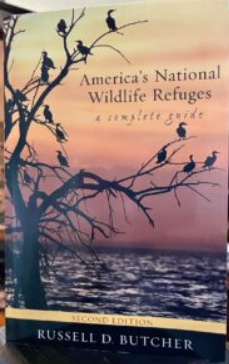
“America’s National Wildlife Refuges:A Complete Guide,” by Russell D. Butcher
The Butcher guide does not have as much information on each refuge, but it is able to cover the entire national system in one book because of that. So it’s handier for a longer-range tour. It also contains a helpful list of contact information for every Friends group in the system, as well as a good list of related reading options.
— Dick Moss

“The Wind Birds: Shorebirds of North America, by Peter Matthiessen
This modern classic of the nature writing genre details the wondrous life histories of North America’s diverse shorebird species. Matthiessen — winner of the National Book Award for “The Snow Leopard” — provides an elegant and engrossing account of shorebird behavior, evolution, migration patterns, and tenuous prospects in an age of increased existential challenges.
— Chris Hollister
“On Trails: An Exploration,” by Robert Moore
This book is part travel memoir, part natural history, part anthropology, and part philosophy. The author uses his travels, especially his adventures thru-hiking the Appalachian Trail, to examine how trails both physical and metaphorical shape the human experience. From the trails left by prehistoric organisms in ancient mud to the pheromone trails of ants and the generationally followed paths of elephants, he discusses the importance of trails in science and evolution. Through a series of studies and anecdotes the author guides the reader through this broad array of topics following a branching trail of his own creation.
— Emma DeLeon


“The Backyard Bird Chronicles” by Amy Tan
A lovely journal that chronicles Tan’s education as a backyard birder — her hits, misses and observations of the birds that visited her yard in California. Tan has a keen eye for detail and is such a talented writer. This book can help you see nature in a new light and teach you what to look for. She also includes numerous sketches of her avian visitors and discusses her drawing process, which will no doubt be of interest to those with an interest in art. The drawings are accompanied by some of her handwritten notes, interesting in their own right.
— Dick Moss
“The Bluebird Book: The Complete Guide to Attracting Bluebirds,” by Donald and Lillian Stokes
This book is a richly illustrated, user-friendly guide aimed at backyard nature enthusiasts who would like to attract and support bluebirds. The authors provide a mix of practical how-to’s, natural history, and conservation context.
— Garner Light


“The Sibley Guide to Birds: 2nd Edition,” by David Allen Sibley
One of the most highly respected and most used bird ID guides for serious and beginner birders alike. The updated second edition was published in 2014 and is known for its detailed illustrations of birds in a variety of plumages and postures. The guide points out the most important field marks for each species and includes a brief description of key life history and behavioral characteristics.
— Emma DeLeon
“Birds of New York Field Guide,” by Stan Tekiela
We use this all the time and reference it so often, we have a couple of copies scattered about the house near windows. This book has been out for 25 years, but it is still available. I am including it because it has proved invaluable to us in identifying and learning about the birds we see in our backyard and elsewhere.
— Dick Moss


“Return to the Sky: The Surprising Story of How One Woman and Seven Eaglets Helped Restore the Bald Eagle,” by Tina Morris
Great read that happened here in New York at our sister refuge, Montezuma! The woman overcame many fears, and stigmas of women at the time she was in this program, early ’70s. Even if you thought you knew the story behind the return of the Bald Eagle here to New York State, this book will give you much more insight from the woman who was quote, momma eagle!
— Amy Merritt
“The Bald Eagle: The Improbable Journey of America’s Bird” by Jack E. Davis
This excellent book has some information on bald eagle habits and habitats, but it is mostly a history of the bald eagle in U.S. popular culture, why it became the national symbol, how its reputation changed drastically over the years, and the heroic efforts to bring it back in the Lower 48. If you know someone who is both a nature lover and a historian, this should be right up their alley.
— Dick Moss


“Kingbird Highway: The Biggest Year in the Life of an Extreme Birder,” by Kenneth Kaufman
Kenneth Kaufman, who is now regarded as one of North America’s leading birders, left home at age sixteen and spent a year crisscrossing the country to see as many bird species as possible in a birding competition known as a “big year.” Now considered a cult classic, this memoir chronicles the subculture of birding in the 1970s and a teenager’s search for himself during an adventurous, yearlong odyssey.
— Chris Hollister (this title was also recommended by Emma DeLeon)
“The Hidden Life of Trees,” by Peter Wohlleben
A delightful little book. We tend to think of trees as solitary beings because that is what we see above ground. In reality there is a web of sorts that connects trees in a forest. We still do not fully understand how it all works, but people like Peter Wohlleben are making it clearer all the time. He has a series of books on related topics that’s worth checking out.
— Dick Moss


“Crossings: How Road Ecology is Shaping the Future of Our Planet,” by Ben Goldfarb
This book discusses the many and profound ways that roads affect ecosystems, wildlife, and even human communities. The author brings to the forefront the little-known study of road ecology, which examines the impacts of roads on ecosystems including habitat fragmentation, animal deaths from roadkill, pollution, and changing the character of human communities. it is a fascinating read filled with interesting anecdotes and studies. There are also many hopeful and uplifting sections that discuss innovative efforts being developed to reduce and mitigate the damage caused by roads.
— Emma DeLeon
“The National Wildlife Refuges” by Robert L. Fischman
This is the bible for the legal underpinnings of the refuge system. If you really want to know about the refuge system and its management, give this a try. Fair warning: It rates a 10 out of 10 on the policy wonk scale, so choose your recipients for this carefully.
— Dick Moss

I’d also add Last Child in the Woods by Richard Louv, Balanced and Barefoot by Angela Hanscom, and 1000 Hours Outside: Activities to Match Screen Time with Green Time by Ginny Yurich.
Add wild by design: “the rise of ecological restoration” to the list